

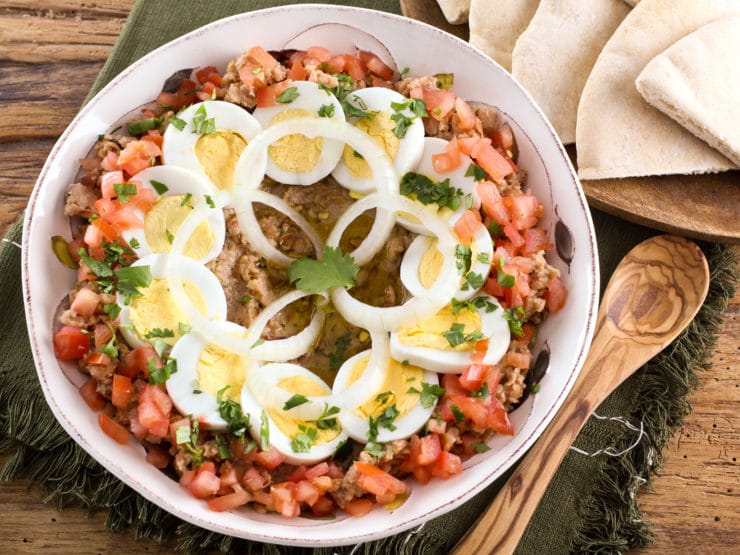
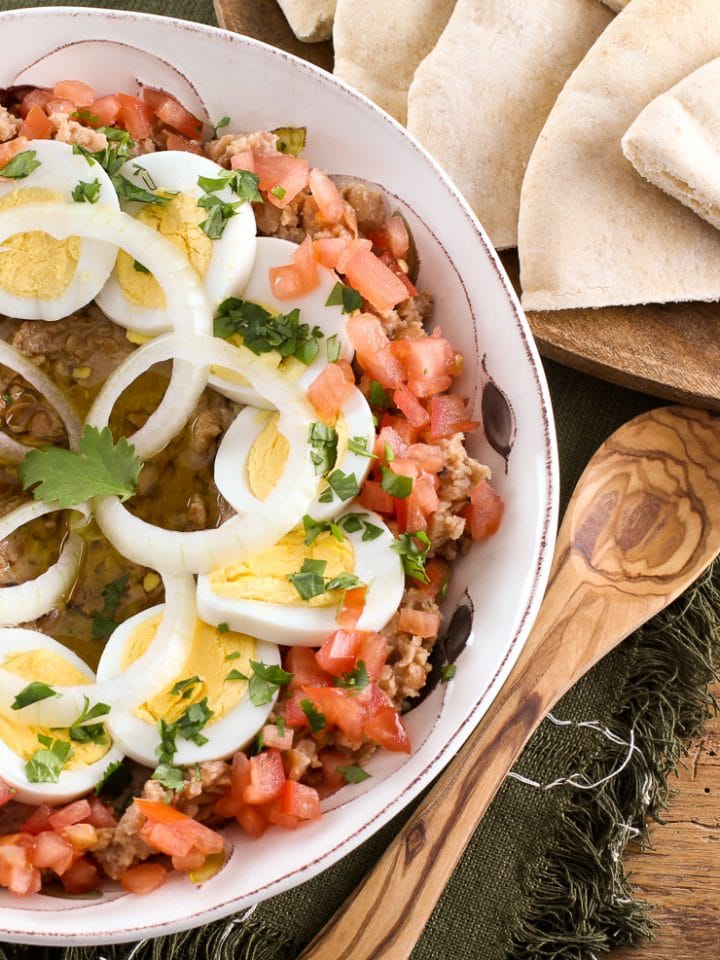
Ful Mudammas – Learn a historical Middle Eastern recipe from ancient times made with fava beans, olive oil, onion, garlic, and cumin. Ancient Israelite cooking.
The fava bean porridge of the donation
and the garlic and oil of daily life…
– Mishna Tvul Yom 2, 3
For Throwback Thursday, I’m revisiting one of the first recipes I covered on my blog – Ful Mudammas. This refreshed version features beautiful new photographs by my talented friend Kelly Jaggers.
I’ve always been curious about the recipes and ingredients of ancient Israel: the grains, meats, vegetables, fruits and spices that were consumed in Biblical times. This period in history has always fascinated me, especially the food—what was eaten, how it was prepared and the ways it was served. Finding out how people lived thousands of years ago is like putting together a complicated puzzle with lots of missing pieces. We rely on the research of archaeologists, historians, and the surviving texts from this period—the Talmud, Roman writings, and of course the Bible. Here, we read the Bible as a history book, gleaning clues from both the Torah and the New Testament to determine the important role food played in Biblical times.
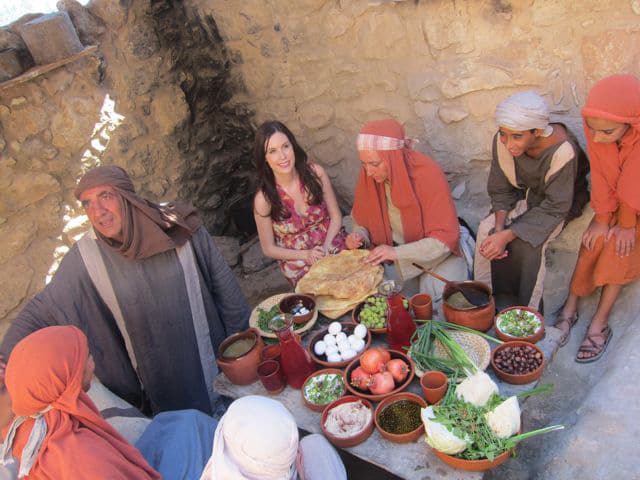
At Nazareth Village in Israel learning about Biblical cuisine
A few years ago I visited two places in Israel that offer a rare glimpse at ancient Biblical life: Nazareth Village and Neot Kedumim Biblical Landcape Reserve. Both of these locations offer a unique opportunity to experience what life was like for the ancient Israelites. At Neot Kedumim I met with Dr. Tova Dickstein, who is known worldwide as an expert on ancient and Biblical foods. She’s been interviewed by National Geographic and the History Channel, as well as the Naked Archaeologist. Tova generously shared her extensive knowledge of Biblical foods with me, which made for a fascinating afternoon.

Tova gave me an educational tour of Neot Kedumim. The reserve stands above a valley where archaeologists have unearthed one of the oldest known agricultural communities. Neot Kedumim was established in the 1960’s by Noga Hareuven, a well-known biblical botanist. He wanted to create an educational park where the landscape would reflect the physical setting of the Bible. The plants, trees and crops that grow there reflect the flora of ancient Israel. After the park was established, archaeologists discovered some incredible things at Neot Kedumim, including ancient wine and olive oil presses. The park also contains reconstructed wheat threshing floors, water cisterns, and ritual baths.
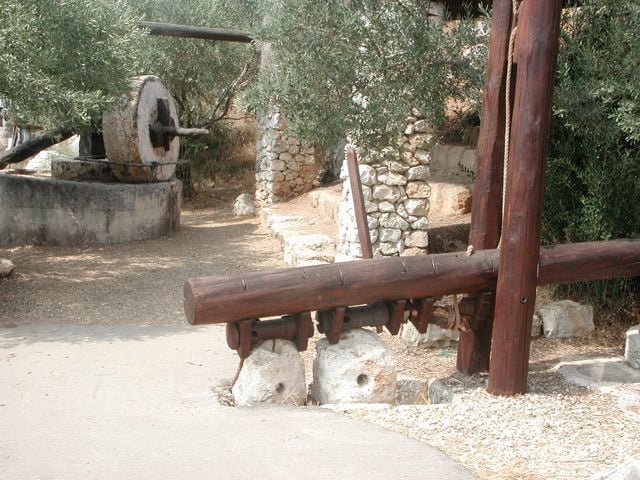
Reconstructed ancient olive press at Neot Kedumim
If you’re planning a trip to Israel and you have an interest in Biblical history, I recommend a visit to Neot Kedumim. Here is a link to their website if you want to learn more:
Neot Kedumim Biblical Landscape Reserve
At one point during our interview, I asked Tova what the main protein source was for the ancient Israelites. She explained to me that meat was rarely consumed because it was too expensive for the majority of ancient Israelites; it was considered a “luxury” and was eaten sparingly. They ate a largely vegetarian diet that relied heavily on grains, Mediterranean vegetables, fruits, and legumes. One of most popular legumes in the Biblical diet was the “broad bean,” or what we refer to today as the fava bean.
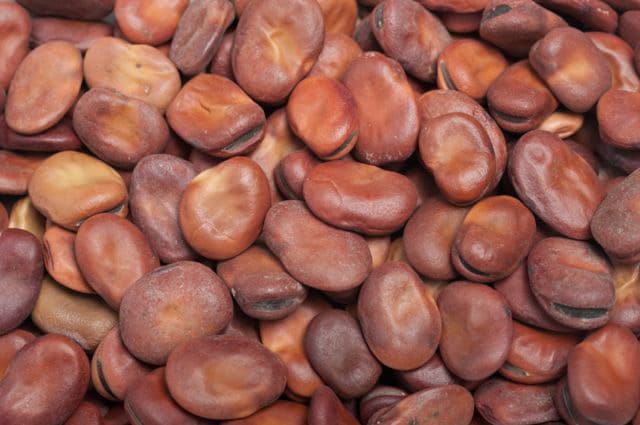
Fava beans are one of the oldest domesticated food legumes. References to fava beans occur in both the Talmud and the Mishna, indicating they have been part of the Middle Eastern diet since at least since the 4th century. During our interview, Tova told me that fava beans were likely one of the main protein sources for the ancient Israelites. In fact, the ancient method for cooking fava beans is discussed in the Talmud. The beans were immersed in a pot of water, sealed, then buried beneath hot coals so they could slowly cook.
Ful mudammas (pronounced fool mu-dah-mahs), a popular Middle Eastern dish made from fava beans, bears similarity to this ancient method of cooking. Sometimes spelled foul mudammas and often referred to as simply “ful,” this dish is served throughout the Middle East. Ful is known for making you feel full and satisfied due to its high fiber content. In Muslim countries ful is often eaten during Ramadan before sunrise so people can fast more easily during the daylight hours. It is sometimes served on top of chickpea hummus in a dish called “hummus ful.”
Ful mudammas is served in different ways throughout the Middle East; it is particularly popular in Egypt and Lebanon. Some countries top it with hard-boiled egg, others like it with chopped fresh tomatoes. Some serve it mashed, others leave the beans whole. The base of the dish tends to be the same everywhere, including fava beans, garlic, lemon juice and olive oil. Lemon wasn’t cultivated in Israel at the time of the Torah, though there was a similar citrus fruit called a “citron” that was sometimes used in cooking. That said, lemon juice adds a terrific flavor to ful mudammas. If you would like to keep it strictly Biblical-style, cut the lemon. The rest of the ingredients were available and common to the ancient Israelites.
Ful muddamas is traditionally served for breakfast or lunch, sometimes together with hummus, alongside fresh warm pita bread. The bread is used to scoop up the fava beans. Personally I find this dish quite filling without the bread, so those of you who are gluten-free can readily enjoy this recipe too. I usually use roasted garlic in my ful, which is easier to digest than raw. Either can be used; raw garlic will have a stronger flavor in the finished dish.
Food Photography and Styling by Kelly Jaggers
Recommended Products:
We are a participant in the Amazon Services LLC Associates Program, an affiliate advertising program designed to provide a means for us to earn fees by linking to Amazon.com and affiliated sites. As an Amazon Associate I earn from qualifying purchases.
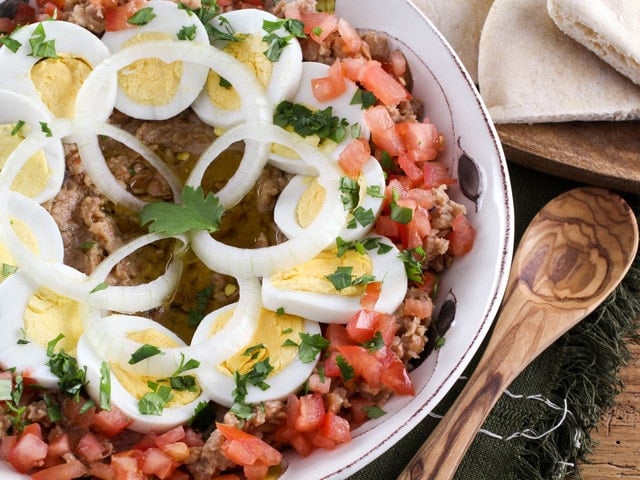
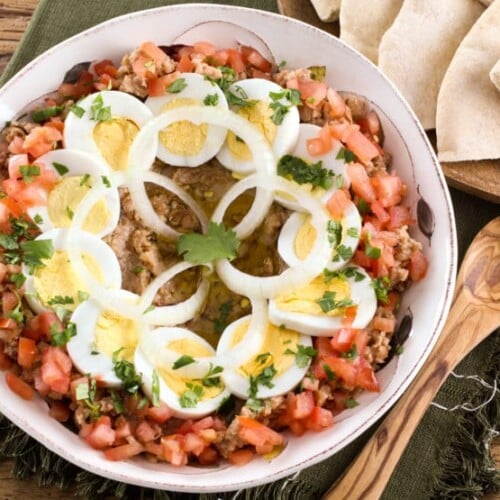
Ful Mudammas
Ingredients
- 2 cups peeled and cooked or canned fava beans 16 oz
- Extra virgin olive oil
- 1/2 onion minced
- 2 cloves garlic, raw or 4 roasted - see notes
- 1 teaspoon cumin
- 1/2 cup water
- Salt and black pepper to taste
- Juice from 2 fresh lemons or more to taste
Optional Toppings
- Sliced hard boiled egg (if making vegan do not use)
- Diced ripe red tomato
- Raw onion sliced into rings
- Fresh minced parsley or cilantro
- Red chili pepper flakes
- Paprika
- Tahini sauce
NOTES
Instructions
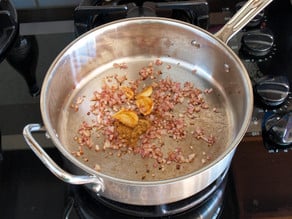
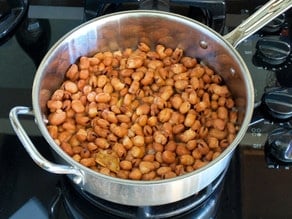
- If cooking dried fava beans, prepare them using the instructions on my blog - How to Prepare Fava Beans. If using canned fava beans, pour them into a colander to drain. Rinse the beans in cold water. Set aside, then continue with recipe.In a large skillet, heat 1 tbsp olive oil over medium heat. Fry the diced onion till it becomes translucent and golden. Add garlic and cumin, sauté for 1 minute till fragrant. Add the fava beans to the pan, then add about ½ cup of water to the skillet. Bring mixture to a boil. Reduce heat to medium low, season with salt and pepper to taste (I usually add about ½ tsp salt and 1/8 tsp of pepper). Cover the skillet.

- Let mixture simmer for about 10 minutes on medium low heat until the beans are nice and tender. Remove lid from pot and continue to cook until the liquid has reduced by about 75 percent. Remove from heat.
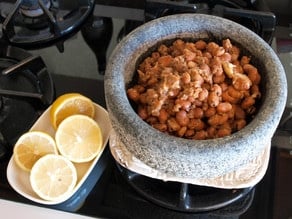
- Pour the fava bean mixture into a mixing bowl. Squeeze in the fresh lemon juice. Mash the mixture to a semi-smooth consistency; it should be a little more chunky than hummus. For a mashing tool, I like to use my spice pestle. You can also use a potato masher or the back of a large metal spoon.
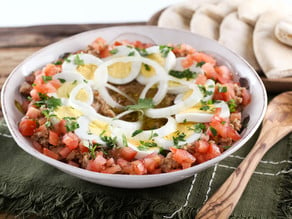
- Serve each portion on a plate as you would hummus. Create a shallow basin in the center of the ful mudammas. Drizzle olive oil lightly inside the basin, then garnish with the ingredients of your choice. Serve hot.
Nutrition


Question: I followed your recipe to the T, even “how to prepare fava beans” since I used dried beans… but it turned out the color of hummus. I’ve tried several different recipes for ful medames and they always turn out the same color. Tastes good, but I’m not sure why it’s such a pale color. Should I not peel all of the beans? Maybe leave some skins on? The beans are certainly brown before I peel them. I’m not sure what I’m doing wrong.
This may simply be due to natural variations in the fava beans you purchase. As long as it tastes good, I wouldn’t worry!
I grew a lot of field beans (aka fava beans) as a green manure. We enjoyed this recipe so much (made from fresh beans) we think we prefer them to regular broad beans. Thanks for the info on cooking from fresh as most recipes assume you have dried or tinned.
I didn’t think it was going to be good while I was cooking. I was pleasantly surprised. It was delicious and filling. The lemon juice made the whole recipe for me.
Hi 🙂 In the picture it looks as the fava beans were not peeled. I wanted to ask in order to make sure because when I peel that final layer and only the softer part remains I find that the characteristic odor and taste suffers. This has been a real mysteri to me – what’s the proper way to prepare it? Maybe there are more than one shells and that’s why the recipe calls for peeled.
You can find more info on fava beans here: https://toriavey.com/how-to/fava-beans-how-to-cook-soak-peel-freeze/
ate these cooked Fava beans for breakfast every day while visiting in Jordan. I now can find fava beans ready to use frozen in my grocery store – Yay, Now I am ready to go with your recipe.
This is a favorite dish of mine and I’ve shared it with many loved ones here in the U.S. since first stumbling upon this recipe 2+ years ago. It’s definitely evolved over time: I tend to use whatever canned beans I have on hand and always top with the egg fried and crispy. Favorite toppings to set out are parsley, green onion, cilantro, mint, jalapeño / chili peppers, red onion, grape tomatoes or salsa, feta, hot sauce, wedges of lemon and lime. Beautifully simple, though lots of chop time this way — and absolutely worth every minute for so many flavors, colors, and textures. I’m plotting to make a lime-yogurt sauce for the next time I make this for friends (who are just as wild as I am about ”the bean dish”). I’ve never felt the need to eat it with pita or anything similar; it is so delicious and filling on its own.
Thank you, Tori, for passing on this incredibly special dish along with its history. I will be making it always! Blessings!
Love these ideas! So glad you’re enjoying it 🙂
Husband and I loved it..
Weird-
Stopped here for the garlic roast then Google sent me here for Ful!
I lived briefly on Zamalek, an island in the Nile within Cairo and fell in love with Ful.
So finding a great recipe for it here is wonderful. Your take on it is perfect. My kitchen smells wonderful and
I especially love the ancient nature of this!
I discovered Ful Madammas about 4 years ago as an expat in West Africa and ate is regularly for lunch with flat or pita bread. It’s great for a hearty breakfast paired with scrambled eggs.
Yes we eat this in Egypt too as well. I am an American Muslim Revert who now lives in Egypt.
We eat the foul not only for Ramadan but any time of the year. Its very good and you can get a variety of ways to eat it. Some people do with eggs and some drizzle a little olive oil some add salad or some eat plain or with potato chips, either way its delicious I really enjoyed your article
Delicious thank you for a healthy and plant based breakfast alternative. Magnificent in its texture taste and flavor profile from ancient history
looking forward to your emails, love your recipes. thank you
What if I have access to fresh favas? I often use them in salads. I pluck the beans from the pod, blanch for 30 seconds or so and then peel off the shell. They are bright green. Could I use them to make this dish? Just cook them until they are soft and tender?
Ful is made with dried beans, not fresh green ones. You can try it, but the resulting dish would not be considered ful mudammas– it might be nice though. 🙂
Instead of using fava beans, I use Azuki/Adzuki/Choli beans, bought at an Indian supply store, which are smaller and more flavorful. After soaking the beans, I put in a small amount of chopped onion and cumin in the pressure cooker with the beans ( once I put in dried Italian spices). When the beans have finished cooking, I pour off the ‘broth’, retaining about ½ cup, and then add the salt, pepper, ½ minced raw onion, garlic, cumin, EVOO, sesame oil (instead of tahini) and lemon juice. I realize it may not be authentic Ful, but definitely a nice flavorful twist to the dish, which I eat for breakfast and lunch.